
Stable Wells. Clear Drainage. Unobstructed Access.
Window Well Installation in Lapeer, MI
Install or replace a window well with the correct dimensions, foundation attachment, drainage base, grade transition, and access features.
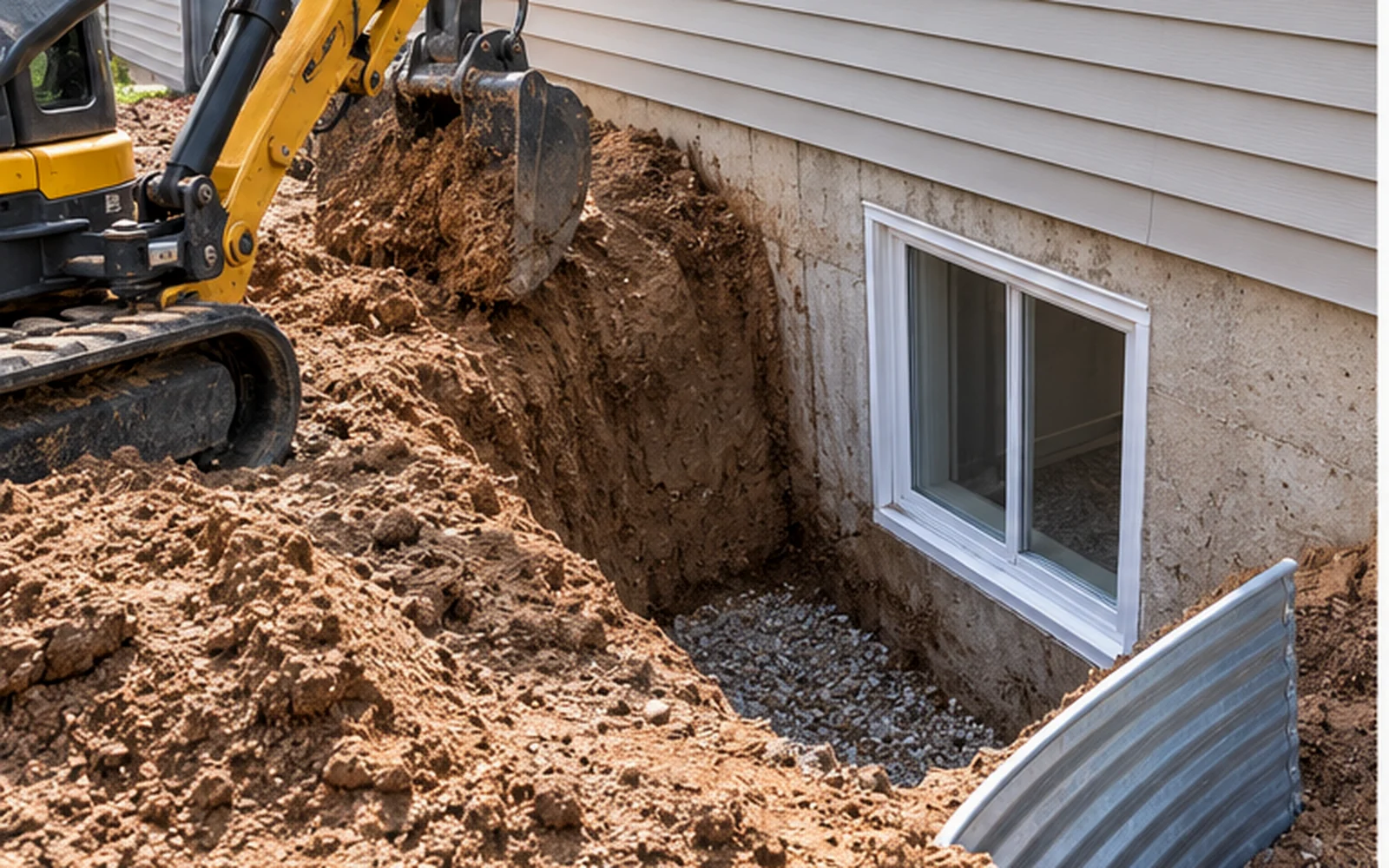
A window well looks like a simple thing: a curved piece of metal or plastic sitting against the foundation under a basement window. It does not look like a piece of engineering. But in Lapeer County, the window well is one of the most important parts of a basement window system, and the difference between a good one and a bad one shows up within a couple of winters. This page is about what window wells actually do, why they fail, and what proper window well installation looks like.
What a Window Well Is Really For
Here is the thing most people miss: a window well is not decorative. It has three jobs, and they all matter. First, it holds back the soil so a below-grade window can open and bring in light. Second, it collects and drains the water that would otherwise sit against the window and work its way into the basement. Third, for an egress window, it is part of the escape route, the space a person climbs into and out of.
When homeowners describe their well as “just the thing around the window,” they are usually living with a well that is doing its first job poorly and the other two not at all. We have pulled plenty of wells that were purely cosmetic: too small for the window to open fully, no drainage at the bottom, and sitting loose against the wall. Those wells do not protect the window. They just dress it up.
The Different Kinds of Wells We Install
Galvanized and Coated Steel
The classic corrugated metal well is what most people picture, and it is still a great choice when it is done right. Galvanized steel is strong, rigid, and holds up to the soil pressure around it. We coat and paint the steel wells we install so they do not rust out in the wet ground, because a bare galvanized well sitting in clay for fifteen years will eventually pit and bleed rust down the foundation.
Aluminum
Aluminum wells are lighter and will not rust like steel, and they come in clean, modern shapes. They are a strong choice for egress wells where you want a larger opening and a finish that stays looking good. We fasten them the same way, bolted and anchored, because light weight is not an excuse for a well that walks away from the house.
Plastic and Poly Wells
Plastic wells are popular for replacement work because they are affordable and never rust. The catch is that cheap plastic wells can flex and deform under soil pressure and frost, especially in deep installations. We use heavier, bracing plastic units for below-grade work and we anchor them like any other well. In the right application they are perfectly good. In the wrong application they end up bowed and full of leaves.
Sizing a Well: Egress vs. Everything Else
The size of the well is decided by the job it has to do, and the code draws a clear line. For an egress window, the well must be big enough that the window can open fully, and the open window must leave enough space for a person to get through it and into the well. For a deeper well, that means more width. We do not just order the well that matches the window brochure. We measure the actual opening and buy the well that lets the window do its job.
For a non-egress basement window, the well still has to be sized so the window can open and be cleaned, and it should be generous enough that rain and snowmelt drain instead of sitting against the glass. A well that is barely wider than the window is a maintenance problem from the start. In our experience, homeowners never regret going a size up. They regret the cramped little well that collects water and leaves.
Why Wells Pop Off the Wall (and How We Keep Them On)
This is the failure we see most often, and it is worth understanding because it is so easily prevented. A well is buried in soil that freezes and thaws all winter. When water gets into the backfill and freezes, it expands, and that expansion pushes up and out. A well that was never anchored gets shoved away from the foundation, sometimes an inch, sometimes six. Once it pulls away from the wall, it leaks, it lets soil in, and it stops doing its job.
The fix is boring and permanent: we anchor the well to the foundation. Every well we install gets fastened through the well into the wall with the right masonry fasteners, not just set in place and backfilled around. On top of that, the drainage at the bottom of the well keeps the water from pooling in the backfill in the first place, and the backfill itself is compacted in layers so it does not hold excess water. Anchor it, drain it, compact it. That is the whole trick, and it is the trick that makes a well stay put for decades.
Drainage Is Eighty Percent of the Job
If we had to pick the single most skipped step in window well work, it is the drainage. A well sits in the ground, below grade, in a region with clay soil and wet springs. If the bottom of the well does not drain, the well is a bucket. Water collects, sits against the window, and finds its way in through the lowest point it can. We have been on plenty of calls where the homeowner thought the window was leaking when the real problem was a well full of standing water.
The right setup is a base of gravel in the bottom of the well over a drain that carries water away from the foundation. In many installations we connect the well drain to a pipe that runs to daylight or ties into the exterior drainage system. The goal is simple: water should never sit in the well, and it should never sit against the foundation. When that is handled, a window well becomes a dry, reliable part of the house, and the window inside it stays dry for decades.
Ladders, Backfill, and the Details That Matter
When a Ladder Is Required
If the bottom of the well is more than 44 inches below grade, the code requires a permanently attached ladder or steps. We install ladders in deep wells as a matter of course, anchored so they are solid and cannot be pulled loose. A ladder in a window well is not for decoration. It is for the moment when somebody has to get out of that basement in a hurry, and it has to work.
Backfill and Compaction
After the well is set, the soil around it goes back in the right way. We backfill in layers and compact as we go, so the soil does not settle over the next few months and pull the well down. Loose backfill also holds more water, which feeds the frost heave we talked about. Proper compaction, like anchoring, is invisible when the job is done, and it is exactly what keeps the well where it belongs.
Grading Around the Well
Finally, the ground around the well has to shed water away, not toward it. We slope the final grade away from the well and the foundation so surface water from rain and snowmelt does not drain straight into the well. This is one of those steps that seems small and is enormous. A well with perfect drainage at the bottom can still fill from the top if the yard funnels water into it.
Measuring for the Right Well
We get calls from homeowners trying to order a well for a window they already have, and the first thing we ask is what dimension they measured. Most people measure the window. That is not the number that matters. What matters is the width of the opening in the foundation wall, the depth of the well needed to let the window open and to provide egress, and the clearance required by the code for the well to count. The well has to fit the opening and the egress route, not just look like it pairs with the glass.
This is where a lot of hand-installed wells go wrong. The homeowner measures the visible window, buys a well that matches the width, and ends up with a well that is too small for the opening and too cramped for egress. The code dimensions for a compliant well are specific, and they involve the area of the well and its depth, not the glass width. When we size a well, we size it to the opening, the depth, and the egress clearance, and we tell you the numbers so you understand why the well is the size it is.
Window Well Installation FAQ
How big should a window well be?
For an egress window, the well must be large enough for the window to open fully with room to climb out, and if it is deep, it needs a ladder. For a standard basement window, the well should be wide enough that the window opens and cleans easily and drains properly. When in doubt, go bigger. A generous well is never a mistake.
Do window wells need to be anchored?
Yes, in our climate, absolutely. A well that is not fastened to the foundation gets pushed away by frost heave over the winters, and once it separates from the wall it leaks and lets soil in. We anchor every well we install, and we recommend having an unanchored well re-anchored before it becomes a problem.
What is the best material for a window well?
For a below-grade egress well, a rigid steel or aluminum well sized properly and anchored well is hard to beat. Plastic wells have their place and work fine when they are the right, sturdy unit, but the cheap flexible ones deform under soil pressure. Material matters less than anchoring, drainage, and backfill, but we steer homeowners toward steel and aluminum for the long haul.
My window well fills with water. What should I do?
First, understand that a well that holds water is missing its drainage, and that needs to be fixed, not worked around. We install gravel beds and drains at the bottom of wells and, where needed, run the water away from the foundation. We also check the grading so surface water is not draining in from above. Then we would recommend a cover to keep out the bulk of the rain and debris, but the drainage is the fix.
Does every egress window need a window well ladder?
Only when the bottom of the well is more than 44 inches below grade. Many egress wells are deep enough to trigger that requirement, and we install a permanently attached ladder or steps in every one of those. Even when it is not strictly required, a ladder or steps in a deep well is a good idea for safety.
Can I install a window well myself?
A surface-level well on a shallow window is within reach of a careful DIYer. An egress well, with excavation, drainage, anchoring, and backfill, is a different animal, and the mistakes are expensive and wet. If the well is doing egress duty, that is a professional job. If it is simply dressing up a small window, know what you are getting into before you start digging.
Why is my window well rusting?
Bare galvanized steel sitting in wet clay will eventually pit and rust, especially where the coating is scratched or where it sits against the soil. That is why we coat and paint the steel wells we install. If yours is rusting, it can often be cleaned, coated, and re-anchored rather than replaced, and we can tell you which way to go after looking at it.
Does a window well come with a window?
No, they are separate components, and they are usually installed together as one system. The window, the well, the drainage, and the cover all have to work with each other. We install them as a package so the sizing, the anchoring, and the drainage are coordinated. A well bought separately and bolted on later often fits poorly and drains worse.
Give Your Basement Windows the Well They Deserve
A window well is a small investment in a part of the house that is easy to ignore and hard to forgive when it fails. The right well, sized properly, anchored to the foundation, and drained correctly, turns a basement window into something you simply never think about again. The wrong well is a leak, a rust stain, and a repair you will make in the mud some wet spring.
If your wells are old, loose, undersized, or full of water, let us look at them. We will tell you honestly whether a repair will do or whether a new well is the right call, and we will build it the way it should have been built the first time. That is the standard we hold every installation to.
Sizing and Draining a Window Well in Lapeer
For an egress window, Michigan Residential Code R310 requires a window well with at least 9 square feet of floor area and a horizontal projection of at least 36 inches from the wall. If the well is deeper than 44 inches, it needs a permanently attached ladder or steps that do not reduce that clear area. We set steel or composite wells to those numbers rather than to whatever fits the hole.
The well is excavated below the local 42-inch frost depth, bedded in stone, and connected to the foundation drain so water leaves instead of pooling. Backfill is compacted in lifts and the grade is pitched away. See the window well and cover cost guide and our drainage guide.
Related Guides
Ready to Schedule Service?
Contact us now to discuss your project, review the next steps and schedule service.